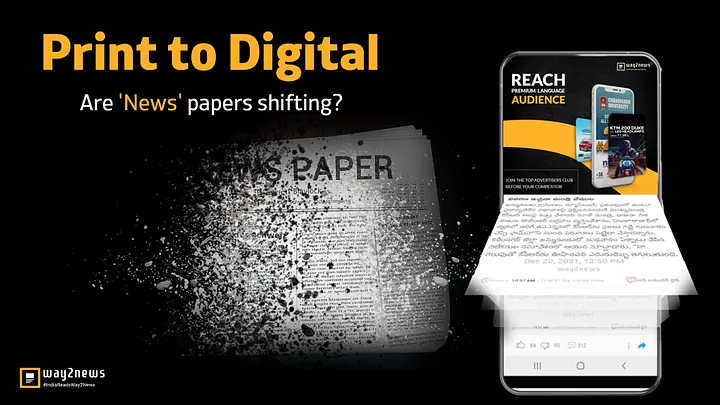
Way2News, India's largest hyperlocal news app covers news from 400 districts and generating more than 4 billion screen views every month - that's 3 times the entire Indian population. The most devastating realization in Good Bye, Lenin
Let your friends read the news you intend to share with them.
Travel, Health, Finance & many more- Pick Magazines of your favourite topic and lay back to read.
Cinema, Business or sports, read the News from the category of your preference.
Reading in dark? Then make it better for your eyes with 'Night Mode'
Read the News articles at ease by just flipping them up and down.
Participate in Polls on different issues and contribute your opinion to country wide taken stats.
Read the most trendy and widely shared flips from 'Top Buzz'.
Save the articles you want to revisit by adding them to 'My bookmarks'.
Way2News brings real time news. We understand your reading preference and promise to deliver personalized news flips.

The most devastating realization in Good Bye, Lenin! is that the wall was never just made of concrete. It was made of habit, memory, and belief. Alex’s elaborate deception forces him to confront his own nostalgia. He doesn’t miss the Stasi or the shortages; he misses the safety, the community, and the version of his mother who was strong and purposeful. The West German consumer goods his friends celebrate—the IKEA furniture, the McDonald’s burgers, the endless TV channels—feel shallow and disorienting.
However, the film’s deeper power is its aching tenderness. It is a profound meditation on loss: the loss of a parent, the loss of an identity, and the loss of a home that no longer exists. Christiane is not a caricature of a communist zealot; she is a woman who genuinely believed in her country’s ideals, who sacrificed for it, and who cannot reconcile the world she built with the one that replaced it. Alex’s lie is not political—it is an act of desperate, impossible love. The title is the film’s most ironic statement. We say “Good Bye, Lenin!”—a farewell to the statue of the communist icon that Alex wheels past the cheering crowds. But the film argues that we never truly say goodbye.
In a poignant twist, we learn that Christiane was never the naive true believer Alex assumed. She had been preparing to flee to the West years earlier, but chose to stay for her children. The very lie Alex tells to protect her is based on a false image of who she was. This revelation reframes the entire film: we are all living inside a carefully constructed fiction, whether it’s a simulated GDR or the idealized memory of a parent. Good Bye, Lenin! remains relevant because the post-Cold War triumphalism it subtly critiques has faded. In an era of resurgent nationalism, political disinformation, and “filter bubbles,” the film feels prescient. We no longer build walls of concrete; we build them with algorithms, partisan news, and curated identities.
The final scene is a masterpiece of quiet resolution. Christiane finally leaves the apartment. Alex wheels her to a park where a helicopter flies a giant advertisement for a candy bar. He braces for her shock. But she just watches, smiling peacefully. She doesn’t need the lie anymore. She has made her peace with the end of her world. Good Bye, Lenin! is not a film about the victory of capitalism over communism. It is not a simple East-vs-West morality tale. It is a film about the stories we tell ourselves to survive. It argues that nostalgia is not a political stance, but a human condition. We are all, in our own way, building small, hidden GDRs in our minds—preserving a past that never quite existed, in order to say a proper goodbye to a present that never stops changing.
Doctors warn Alex that any sudden shock could kill his fragile mother. So, he makes a radical decision: he will rebuild the GDR inside their small apartment. With the help of his sister and a crew of disillusioned friends, he manufactures fake news broadcasts, scours dumpsters for old pickle jars, and convinces his mother that the world outside is just as she left it. On the surface, Good Bye, Lenin! is a hilarious farce. The image of Alex rolling a life-sized bust of Lenin past a giant billboard for Coca-Cola is an iconic visual metaphor for the clash of two worlds. The film’s comedy springs from the absurdity of trying to preserve a dying ideology in a one-bedroom flat.

The most devastating realization in Good Bye, Lenin! is that the wall was never just made of concrete. It was made of habit, memory, and belief. Alex’s elaborate deception forces him to confront his own nostalgia. He doesn’t miss the Stasi or the shortages; he misses the safety, the community, and the version of his mother who was strong and purposeful. The West German consumer goods his friends celebrate—the IKEA furniture, the McDonald’s burgers, the endless TV channels—feel shallow and disorienting.
However, the film’s deeper power is its aching tenderness. It is a profound meditation on loss: the loss of a parent, the loss of an identity, and the loss of a home that no longer exists. Christiane is not a caricature of a communist zealot; she is a woman who genuinely believed in her country’s ideals, who sacrificed for it, and who cannot reconcile the world she built with the one that replaced it. Alex’s lie is not political—it is an act of desperate, impossible love. The title is the film’s most ironic statement. We say “Good Bye, Lenin!”—a farewell to the statue of the communist icon that Alex wheels past the cheering crowds. But the film argues that we never truly say goodbye.
In a poignant twist, we learn that Christiane was never the naive true believer Alex assumed. She had been preparing to flee to the West years earlier, but chose to stay for her children. The very lie Alex tells to protect her is based on a false image of who she was. This revelation reframes the entire film: we are all living inside a carefully constructed fiction, whether it’s a simulated GDR or the idealized memory of a parent. Good Bye, Lenin! remains relevant because the post-Cold War triumphalism it subtly critiques has faded. In an era of resurgent nationalism, political disinformation, and “filter bubbles,” the film feels prescient. We no longer build walls of concrete; we build them with algorithms, partisan news, and curated identities.
The final scene is a masterpiece of quiet resolution. Christiane finally leaves the apartment. Alex wheels her to a park where a helicopter flies a giant advertisement for a candy bar. He braces for her shock. But she just watches, smiling peacefully. She doesn’t need the lie anymore. She has made her peace with the end of her world. Good Bye, Lenin! is not a film about the victory of capitalism over communism. It is not a simple East-vs-West morality tale. It is a film about the stories we tell ourselves to survive. It argues that nostalgia is not a political stance, but a human condition. We are all, in our own way, building small, hidden GDRs in our minds—preserving a past that never quite existed, in order to say a proper goodbye to a present that never stops changing.
Doctors warn Alex that any sudden shock could kill his fragile mother. So, he makes a radical decision: he will rebuild the GDR inside their small apartment. With the help of his sister and a crew of disillusioned friends, he manufactures fake news broadcasts, scours dumpsters for old pickle jars, and convinces his mother that the world outside is just as she left it. On the surface, Good Bye, Lenin! is a hilarious farce. The image of Alex rolling a life-sized bust of Lenin past a giant billboard for Coca-Cola is an iconic visual metaphor for the clash of two worlds. The film’s comedy springs from the absurdity of trying to preserve a dying ideology in a one-bedroom flat.