¡@
¡@
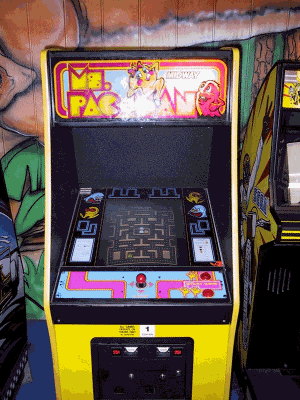
M.A.M.E. ¡]Multiple Arcade Machine Emulator¡^½Æ¦X¦¡¤j«¬¹qª±¼ÒÀÀ¾¹¬O¤@´Ú³]p«D±`§¹µ½ªº¼ÒÀÀ¾¹¡A¥¦¤ä´©¤F³\¦hºØÃþªº¹CÀ¸¡A§K°£ª±®a̪±¬YºØ¹CÀ¸ªºÀÉ®×»Ýn¯S©w¼ÒÀÀ¾¹ªº·Ð´o¡C¨äWindowsª©¥»¤£¶È¾Þ§@²³æ¡A¥\¯à¤]«D±`¦h¼Ë¤Æ¡A¦Ó¥B¨CӤ볣·|±À¥X³\¦h·s¤ä´©ªº¹CÀ¸¡A¦]¦¹¼s¨üª±®aªº³ß·R¡C¦b³o¸Ì©Ò¤¶²Ðªº¹CÀ¸³£¬O¤@¨Ç¦´Á¦b¹C¼Ö³õ©Ò¨ü¨ì¤j®aÅwªïªº¡A¥¦Ì¦³ªº©Î³\¦~¥N¤w¸g¤[»·¡A¦ý¬O¦b·í®É©Ò±aµ¹ª±®a̪º¼Ö½ì«o¬O¥Ã»·µLªk¿i·Àªº¡C¦b¤p®ÉÔ¡A³Ì³ßÅw©Mª¨¶ý¨ì°ª¶¯ªº¤j²Î¦Ê³f¤½¥q³»¼Ó¤W¹Cª±¡A·íµM¥Øªº³£¬O¨º¨Ç¤j«¬¹qª±¡A¨º®Éªº¹qª±¥u¬O³]p¯Âºé®ø»º®É¶¡¡A©Ò¥H³q±`¬O¤£¤Ó»Ýn¥Î¨ì¤j¸£ªº°Ê§@¹CÀ¸¡A¦ý«o³£³Ð·N¤Q¨¬¥B¦³½ì¡A¥un¤@¥´´N¥i¥Hª±«Ü¤[¡C¤£¹³²{¦bªº¤j«¬¹qª±³£¬O¾a¸Ø±iªºµe±©M¼Æ¤£²Mªº¤l¼u±qª±®aªº²ü¥]ÁȨú¸É²ß¶O¡C¦L¶H¤¤¦³¦Wªº¤j«¬¹qª±¦³¤pºëÆF¡B°g»î¨®¡B¯Q¯Y½Ä¾Wºj¡BÂùºIÀs¡BºÆ¨gª¦±èªÌ©M¤p»e¸Áµ¥µ¥¡C³o¸Ì¨S¦³Ô£¢Ù¢Ý¢Ô¢¸¢¸©Î¢±¢¯¢¯¢¯¡B¤]¨S¦³¶V«n¤j¾Ô©Î§Ö¥´±Û·¢Ó¢æ¡A¦³ªº¥u¬O§Úªº....¤]¥i¯à¬O§Aªº¬ü¦n¦^¾Ð¡I
¡@
Meanwhile, Munna’s character deepens. He is not just a brute; he is a son desperate for approval. In a heartbreaking scene, he tries to discuss business with Kaleen, only to be dismissed with, “ Tu abhi bhi bachcha hai � (You’re still a child). Divyendu Sharma plays Munna as a caged pitbull—all fury, no direction. His sexual violence in the first episode is not gratuitous; it’s the show’s way of signaling that Munna’s rage is not revolutionary but reactive. He hurts because he cannot be seen.
The episode ends with the brothers winning their first small victory—intimidating a local landlord. But the cost is moral. They have entered the corridor of mirrors; every act of “justice� brings them closer to Kaleen’s reflection. The Love Trap
The episode’s title— Vasudhaiva Kutumbakam —is a Vedic phrase meaning “the world is one family.� In Mirzapur , it’s a sick joke. The “family� is a pyramid of exploitation, and at the top sits Kaleen, smiling, as his son Munna grows green with jealousy. The Trap Springs Shut Mirzapur S1 -2018- E1-5 Hindi Completed Web Ser...
This episode is the calm eye of the storm. Kaleen delivers a monologue that should be taught in screenwriting classes. He explains to Bablu that his carpet business is a “family�—weavers, dyers, transporters, and (unspoken) killers. “ Yeh Mirzapur hai, � he says. “ Yahan khandan chalta hai, insaan nahi. � (This is Mirzapur. Here, dynasties run, not individuals.)
If you’ve only heard of Mirzapur as a “violent gangster show,� these episodes reveal it as a tragedy. The real villain is not Munna or Kaleen. It’s a system that offers young men only two paths: be the carpet or be the loom. And by Episode 5, the Pandit brothers have chosen—though the choice was never really theirs. Meanwhile, Munna’s character deepens
The inciting incident is brilliant in its mundanity: a stolen inverter battery. The local goon, Munna Tripathi (Divyendu Sharma), son of the uncrowned king Akhandanand “Kaleen� Tripathi (Pankaj Tripathi), crushes a man’s hand for a minor theft. The brothers, trying to mediate, are beaten instead. Their impotent rage is the engine of the next four episodes.
Episode 2 is the training montage —but not for heroes. Guddu and Bablu, after their humiliation, take a loan from a local moneylender to buy guns. The brilliance here is that they don’t turn into killing machines overnight. They practice shooting, miss targets, and nearly shoot each other. They are amateurs, which makes them terrifyingly human. Divyendu Sharma plays Munna as a caged pitbull—all
The butterfly metaphor—beautiful, short-lived, easily crushed—hovers over every scene. Sweety’s father sends goons after the couple. In a stunning sequence, Guddu fights them off with a shovel, killing a man for the first time. The camera holds on his face: not triumph, but vertigo. He has crossed the line, and the butterflies die the moment you catch them. The Philosophy of Poison
Munna, humiliated, decides to act. His “plan� is adolescent and catastrophic: kidnap Sweety’s sister, Rati Shankar’s daughter? No—actually, the show pulls a genuine shock. Munna, drunk and jealous, orders a hit on Guddu and Bablu during a celebratory dinner. The episode ends with a slow-motion massacre: bullets tear through the restaurant, Sweety screams, Bablu takes a bullet for Guddu, and the screen cuts to black.
Here’s a deep, analytical write-up on the first five episodes of Mirzapur Season 1 (2018), treating the Hindi web series as a complete narrative arc within those episodes. When Mirzapur dropped on Amazon Prime in 2018, it was immediately branded as India’s answer to Narcos or Sacred Games ’ rougher cousin. But the first half of Season 1 (Episodes 1–5) is something more deceptive: a meticulously constructed gangster origin story disguised as a power saga. These five episodes don’t just introduce characters—they forge a world where carpets are woven over bullet-riddled bodies, and a college exam can alter the fate of a district. Episode 1: Jhandu (The Loser) Thesis Statement in Blood
But Titliyan is actually a chess move. Kaleen, seeing the brothers’ growing spine, engineers a peace. He invites them to work for him, not as henchmen, but as “legal advisors.� This is the show’s sharpest critique: Bablu, the idealist, genuinely believes they can reform the system from inside. Guddu, blinded by love and revenge, agrees for the money.
¡@
| ^¤å¦WºÙ | ¤¤¤å¦WºÙ | ¦~¥N | ¹CÀ¸¹Ï¤ù¤Î²¤¶ |
| Pac-Man | ¤pºëÆF | 1980 |  |
| Green Beret | ºñ¦â§L¹Î | 1985 | |
| New Rally-X | °g»î¨® | 1981 | |
| Double Dragon | ÂùºIÀs | 1987 | |
| Galaxian | ¤p»e¸Á | 1979 | |
| ¢°¢¸¢³¢² | ¢°¢¸¢³¢² | 1987 | |
| Arkanoid | ¥´¿j¶ô | 1986 | |
| Bomb Jack | ¬µ¼u³Ç§J | 1984 | |
| Senjo no Ookami | ¾Ô³õ¤§¯T | 1985 | |
| Crazy Climber | ºÆ¨gª¦±èªÌ | 1980 | |
| Tenchi wo Kurau | ¤T°ê§Ó | 1989 | |
| Dark Seal | ¶Â·t«Ê¦L | 1990 | |
| Donkey Kong | ¤jª÷è | 1981 | |
| Mag Max | ª÷¿û¦XÅé | 1985 | |
| Final Fight | µóÀY§Ö¥´ | 1989 | |
| Mahjong Gakuen | ³Â³¶¾Ç¶é | 1988 | |
| Argus no Senshi | ¥¼¨Ó¾Ô¤h | 1986 | |
| Makai-Mura | Å]¬É§ø | 1985 | |
| Gemini Wing | Âù¤l¬P | 1987 | |
| Daiku no Gensan | ¤j¤O¤uÀY | 1990 | |
| Hyper Sports | ¬ì®³¦Ì¹B°Ê·|(84¦~ª©) | 1984 | |
| R-Type | R-Type | 1987 | |
| P-47 | P-47 | 1988 | |
| Legend of Kage | ¼v¤l¶Ç»¡ | 1984 | |
| Raiden | ¹p¹q | 1990 | |
| Dragonninja | Às¤§§ÔªÌ | 1988 | |
| Kyukyoku Tiger | Âù²´Ãè³D(¨s·¥ªê) | 1987 | |
| Pastel Gal | ±ÀËJ | 1985 | |
| Bomber Man World | ¬µ¼u¶W¤H | 1992 | |
| Pomping World | Å]°®ð²y | 1989 | |
| Teenage Mutant Ninja Turtles | §ÔªÌÀt | 1990 | |
| Sai Yo Gou Ma Roku | ¦è¹C°Å]¿ý | 1988 | |
| Jigoku Meguri | ¦aº»«_ÀI | 1988 | |
| After Burner | ½Ä¯}¤õºô | 1987 | |
| Space Harrier | ®ÉªÅ¾Ô¤h | 1985 | |
| Nekketsu Kouha Kunio-kun | ¼ö¦åµw¬£ | 1986 | |
| Nekketsu Koukou Dodgeball Bu | ¼ö¦å°ª®Õ | 1987 | |
| Pengo | ¥øÃZ±À¦B | 1982 | |
| Kangaroo | ³U¹« | 1982 | |
| Datsugoku¡GPrisoners of War | ²æº» | 1988 | |
| Street Fighter | §Ö¥´±Û· | 1987 | |
| Kageki | ¤õ¿E | 1988 | |
| Strider Hiryu | ¥XÀ»¸Às | 1989 | |
| Operation Wolf | ¯Q¯÷½Ä¾Wºj | 1987 | |
| Tank Battalion | ©Z§J | 1980 | |
| Bubble Bobble | ªwªwÀs | 1986 | |
| Kuri Kinton | ¥\¨½ª÷¹Î | 1988 | |
| Altered Beast | Ã~¤ý°O | 1988 | |
| Golden Axe | ¾Ô©ò | 1989 | |
| Snow Bros. | ³·¤H¥S§Ì | 1990 | |
| Operation Thunderbolt | ¯Q¯÷½Ä¾Wºj¢± | 1988 | |
| Sangokushi 2 | ¤T°ê§Ó¢± | 1992 | |
| Knights of the Round | ¶ê®àªZ¤h | 1991 | |
| Tokusyu Butai UAG | ¯S®í³¡¶¤ | 1987 | |
| Senjo no Ookami 2 | ¾Ô³õ¤§¯T¢± | 1990 | |
| Ninja Ryukenden | §ÔªÌÀs¼C¶Ç | 1989 | |
| Saigo no Nindou | ³Ì«á§Ô¹D | 1988 | |
| Tank | ¤j©Z§J | 1985 | |
| Tank Force | ©Z§J¤j¾Ô | 1991 | |
| Lost Worlds | ¥@¬É¥½¤é | 1988 | |
| Cadillacs Kyouryuu-Shinseiki | ®£Às·s¥@¬ö | 1993 | |
| Silkworm | Áp¦X§@¾Ô | 1988 | |
| Crime Fighters | µóÀY°«¤h | 1989 | |
| Super Volleyball | ¶W¯Å±Æ²y | 1989 | |
| Shisensho¡GJoshiryo-Hen | ¥|¤t¬Ù¡G¤k¤l¼d½g | 1989 | |
| Area 88 | ¾Ô°Ï¢·¢· | 1989 | |
| U.S. NAVY | ¬ü°ê®üx | 1990 | |
| Phoenix | ªø¥Í³¾ | 1980 | |
| Dragon Breed | ¯«Às¤Ó¤l | 1989 | |
| Great Swordsman | ¦è¬v¼C | 1984 | |
| Bank Panic | »È¦æ¤jµs | 1984 | |
| Moon Patrol | ¯¥¼u¸¨® | 1982 | |
| Moon Cresta | N/A | 1980 | |
| Spartan X | ¦¨Às½ðÀ] | 1984 | |
| Shao-Lin's Road | ¤ÖªL½ðÀ] | 1985 | |
| Tetris (Sega) | «Xù´µ¤è¶ô(SEGAª©) | 1988 | |
| Gradius II - Gofer no Yabou | ¦t©z¨µ¯èÄ¥¢± | 1988 | |
| Michael Jackson's Moonwalker | ¥~¬P¾Ô±N | 1990 | |
| Pac-Mania | ¢²¢Ò¤pºëÆF | 1987 | |
| Super Slams | ÄéÄx°ª¤â | 1995 | |
| Darius | ¤ÓªÅ¾Ô°«¾÷ | 1986 | |
| Street Fighter II¡GThe World Warrior | §Ö¥´±Û·¢± | 1991 | |
| Mat Mania | ºÆ¨gºL¨¤ | 1985 | |
| Mahjong Sister | ³Â³¶©n©f | 1986 | |
| Mahjong Kaguyahime | ®V³Â±N | 1988 | |
| Gals Panic | ¤ÑÅúÅÜ | 1990 | |
| Galaga | ¤j»e¸Á | 1981 | |
| Knuckle Joe | ¥_¤æ¯«®± | 1985 | |
| Dragon Spirit | Às»î | 1987 | |
| Dai Makai-Mura | ¤jÅ]¬É§ø | 1988 | |
| Vigilante | ¥\¤Ò¤p¤l | 1988 | |
| Pocket Gal | ¼²²y | 1987 | |
| Tank Busters | ©Z§J¯}ÃaªÌ | 1985 | |
| Seishun Scandal | «C¬Kª«»y | 1985 | |
| Moon Alien Part 2 | ¤ë²y²§§Î | 1980 | |
| Magic Sword | Å]¼C | 1990 | |
| Black Dragon | ¶ÂÀs | 1987 | |
| Jump Bug | ¸õ¸õ¨® | 1981 | |
| Chase HQ | °lÂÜ¢Ö¢ß | 1988 | |